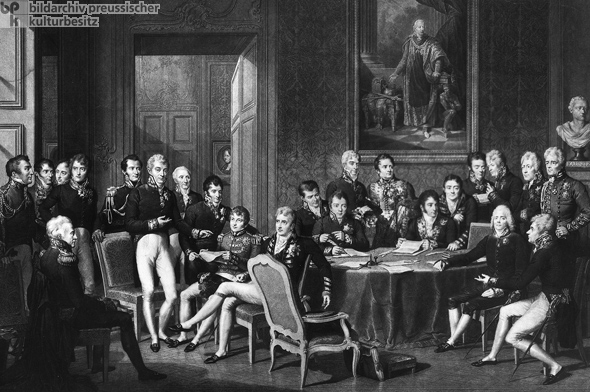
Meeting of the Congress of Vienna, Jean Baptiste Isabey (1814-1815)
http://germanhistorydocs.ghi-dc.org/images/30011286-p%20copy.jpg
The Congress of Vienna, surprisingly held in Vienna, Austria, was a meeting held by Europe's largest powers to discuss what was to become of the world around them. After Napoleon was banished, Europe was left in the ruins of France's control. No boundaries were set in place, revolutions were greatly feared, and governments were in tatters. The great powers at the time, namely Britain, Austria, Russia, Prussia, and France discussed these issues. In class, we were given the task to predict the decision of the Congress on three topics. The first topic or question the Congress tackled was that of the boundaries of the countries. Napoleon had expanded France so much that the borders that existed before were effectively destroyed. What ended up happening, as most of the class guessed, was the reparation of the borders that were in place before Napoleon's influence. However, small changes in the borders were put in place, to ensure a balance of power. The second issue that was covered both in Vienna and in class was that of the ruined governments. Many people wanted to have a democracy like the prospering America, but the leaders present at the Congress only were interested in their own power. The Principle of Legitimacy was put in place, which dictated the idea that rightful monarchs should be restored to the throne. The third and final big point that both the Congress and the class covered was the fear of revolution. The congressmen acknowledged the idea that Napoleon rose from the French Revolution, and the powers were scared that this would happened again. To prevent this and protect their nations and power, they created two principles to deal with this. The first was the Holy Alliance, which described the fact that any revolution was against the will of God, as monarchs had a divine right to rule. The second principle was the Principle of Intervention, which gave any of the great powers the right to help another great power to silence a revolution. England refused to take part in either of these agreements.
These decisions not only protected Europe as a whole, but the power of the people in the Congress itself. One key point that fortified the royalty's strength was the idea of the Holy Alliance. Not only did this prevent revolutions, but it protected the monarchs in general. The principle that was the baseline beneath the Alliance was the idea that the monarchs had a divine right to rule. Religion was very important to all people back then, and to threaten a ruler chosen by God was unspeakable. Of course, the monarchs at Vienna knew this and created this Alliance to protect themselves. This seems a bit greedy, and as history tells, the people of Europe think so too.
I think that the decisions made at Vienna were partly good and partly bad. Making the borders of the countries how they were with the careful balance of power was pretty smart. No country really went to war with another. However, the problem lies internally. The time period after the Congress of Vienna was defined by the numerous revolts in many countries. This is due to a variety of reasons, but many of them boil down to the dislike of the monarchs. People got angry about the strict prohibition of revolution, and once one country revolted, many followed suit. The Principle of Intervention had no use if all of the great powers were invested in their own revolutions, and many people I believe saw this weakness and revolted. I think that if the congressmen had been less greedy with their power and gave some to the people, Europe would have been much more peaceful.

