The Monroe Doctrine was a foreign policy that James Monroe dictated in 1823. It basically stated that Europe should stay out of the Americas and that the Americas should stay out of Europe. At the time, this meant that Europe was not to colonize or retake any parts of Southern and Central America. Today, our current government has to make many choices about foreign policies and relations with other countries, and the Monroe Doctrine is still a key factor in some decisions.
I have chosen an article that covers a foreign policy that the government has recently taken action with, or rather hasn't. This article talks about the Ferguson and Staten Island cases, which have recently dominated the news not only in America but in England, China, Russia, and many other countries. The recent events in these two places have been quite disturbing, not only because of the cruelty of US police officers, but because of the riots as well. As an american myself, I am not only disappointed in the cases but also in the way the public reacted to them. However, the foreign policy comes to play when countries like Russia and China get hold of these stories. They would see America as being weak and unable to deal with issues right there in their own country, like racism and riots. The word of weakness in America could spread to more malicious groups, and if an opportunity to do us harm while we are weak arose no one knows what might happen. But aside from extremist groups, the countries reading about these cases could take away something wrong about how America is truly run.One of the worst things that these countries could see in America and in these cases specifically is police brutality. Communist countries like China would see the great and pure nation of America having its government workers beating and strangling citizens without punishment, so why can't they? Overall, it's a very slippery slope and the article wants to educate people as to not step off the edge.
If the U.S. were following the Monroe Doctrine to deal with these foreign policy issues, that is to stay in your own region, not dominate other countries, and not to intervene, there would be a lot to say. First of all, other countries should not care what was going on in America, because that is in our region and does not affect them in any way. Continuing down this path, there should be no action or intervention by other countries, as again this is an internal affair. Lastly, and most specifically, no country or group should take advantage of us, should we be considered as being in a weak state. I personally think that these three courses of action are quite good, as it not only gives us time to deal with the issues ourselves, but protects the nation while at it.
http://www.newsweek.com/ferguson-and-garner-cases-hurt-us-foreign-policy-289613
Stein, Jeff. "Ferguson and Garner Cases Hurt U.S. Foreign Policy."www.newsweek.com. Newsweek, 5 Dec. 2014. Web. 5 Dec. 2014.
Friday, December 5, 2014

Tuesday, December 2, 2014
Race and Identity in Latin American Revolutions and Today
In class, I studied the Brazilian Revolution. This was the only peaceful Latin American revolution in the 1800's, and it is overall a very interesting story. Brazil was originally a colony of Portugal, and was ruled by the European country for many years. People generally liked the king of Portugal, but he started to become more and more disliked as a revolution broke out in Portugal while the king was away. He had stayed in Brazil far too long, and his mother country did not like the attention the colony was getting. People in Brazil began to realize that they didn't like the king and his poor rule of Portugal. They wanted a new form of government. The king, however, sensing this unrest and not wanting Brazil to fall out of his grasp, appointed his son the ruler of the colony and left for Portugal. Right before he left, he told his son, Pedro, that if he felt any sparks of a revolution, to break free from Portugal and announce himself king. And this is exactly what happened. People got riled up and started to revolt, but Pedro remembered his father's advice and seized the crown, not only stopping the revolution but keeping good relations with Portugal. Very minimal fighting occurred, and Pedro's plan worked perfectly. The revolution was peaceful and did not cause any large changes in the government or to social structure, which led to some problems. Colonial Brazil was, like most other Latin American countries, strictly divided by race, so much so that pictures were made and published describing tens of different races possible. These systems of dividing and categorizing were made by Europeans, mostly to ensure their spot at the top of it all. When other Latin American countries revolted, they did so violently to shake loose the European's tight control. This resulted in the loss of the rigid social structure, and made racism less prominent in the countries. However, with Brazilian's peaceful and small revolution, this change was not made. This resulted in many more years of racism and harsh social structures. Racism in Brazil still exists today, with many people believing that it affects them daily. The white and formerly European citizens have it much better off than other minorities.
Racism does not only affect Brazil today, but the rest of the world. We see even in America today, a country that has taken great steps to make all humans equal, no matter the gender or race, there is racism still present. A current example of this is the tragedy and outrage in Ferguson, where a black victim was shot and killed by a white police officer. Many people claim that this was a result of prejudice that the police officer had towards black people, but many dispute this. The grand jury eventually ruled the latter to be true, enraging some of the locals. This article, Ferguson and the Mythology of Racism written by James Brown, explains the context of racism in the America we know today. Many people still have not gotten it out of their minds that people should not be judged by race or ethnicity or gender, and we can see from this case that the opposite is true as well. This dispute affects not only towns in Missouri but the nation as a whole. Many people think that racism is fine, and many people do not. This issue comes up when dealing with a case such as this one. A white man killing an unarmed black man certainly raises eyebrows. People throw out accusations, saying that racism was the root cause, but others cry self defense. The real reason can never truly be certain, but the thought of racism in our country disgusts most. This case surely will not be forgotten, for it has changed the nation as a whole, bringing lingering racism to light.
http://www.huffingtonpost.com/james-brown/ferguson-and-the-mytholog_b_6228756.html
Brown, James. "Ferguson and the Mythology of Racism." The Huffington Post. TheHuffingtonPost.com, 30 Nov. 2014. Web. 02 Dec. 2014.
Racism does not only affect Brazil today, but the rest of the world. We see even in America today, a country that has taken great steps to make all humans equal, no matter the gender or race, there is racism still present. A current example of this is the tragedy and outrage in Ferguson, where a black victim was shot and killed by a white police officer. Many people claim that this was a result of prejudice that the police officer had towards black people, but many dispute this. The grand jury eventually ruled the latter to be true, enraging some of the locals. This article, Ferguson and the Mythology of Racism written by James Brown, explains the context of racism in the America we know today. Many people still have not gotten it out of their minds that people should not be judged by race or ethnicity or gender, and we can see from this case that the opposite is true as well. This dispute affects not only towns in Missouri but the nation as a whole. Many people think that racism is fine, and many people do not. This issue comes up when dealing with a case such as this one. A white man killing an unarmed black man certainly raises eyebrows. People throw out accusations, saying that racism was the root cause, but others cry self defense. The real reason can never truly be certain, but the thought of racism in our country disgusts most. This case surely will not be forgotten, for it has changed the nation as a whole, bringing lingering racism to light.
http://www.huffingtonpost.com/james-brown/ferguson-and-the-mytholog_b_6228756.html
Brown, James. "Ferguson and the Mythology of Racism." The Huffington Post. TheHuffingtonPost.com, 30 Nov. 2014. Web. 02 Dec. 2014.
Friday, October 31, 2014
Congress of Vienna
In class, we were asked a very important question. What should people in power do to protect it when it is threatened? To tackle this tough question, we studied the Congress of Vienna.

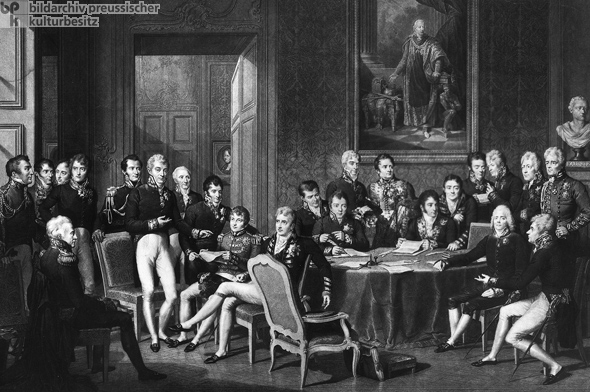
Meeting of the Congress of Vienna, Jean Baptiste Isabey (1814-1815)
http://germanhistorydocs.ghi-dc.org/images/30011286-p%20copy.jpg
The Congress of Vienna, surprisingly held in Vienna, Austria, was a meeting held by Europe's largest powers to discuss what was to become of the world around them. After Napoleon was banished, Europe was left in the ruins of France's control. No boundaries were set in place, revolutions were greatly feared, and governments were in tatters. The great powers at the time, namely Britain, Austria, Russia, Prussia, and France discussed these issues. In class, we were given the task to predict the decision of the Congress on three topics. The first topic or question the Congress tackled was that of the boundaries of the countries. Napoleon had expanded France so much that the borders that existed before were effectively destroyed. What ended up happening, as most of the class guessed, was the reparation of the borders that were in place before Napoleon's influence. However, small changes in the borders were put in place, to ensure a balance of power. The second issue that was covered both in Vienna and in class was that of the ruined governments. Many people wanted to have a democracy like the prospering America, but the leaders present at the Congress only were interested in their own power. The Principle of Legitimacy was put in place, which dictated the idea that rightful monarchs should be restored to the throne. The third and final big point that both the Congress and the class covered was the fear of revolution. The congressmen acknowledged the idea that Napoleon rose from the French Revolution, and the powers were scared that this would happened again. To prevent this and protect their nations and power, they created two principles to deal with this. The first was the Holy Alliance, which described the fact that any revolution was against the will of God, as monarchs had a divine right to rule. The second principle was the Principle of Intervention, which gave any of the great powers the right to help another great power to silence a revolution. England refused to take part in either of these agreements.
These decisions not only protected Europe as a whole, but the power of the people in the Congress itself. One key point that fortified the royalty's strength was the idea of the Holy Alliance. Not only did this prevent revolutions, but it protected the monarchs in general. The principle that was the baseline beneath the Alliance was the idea that the monarchs had a divine right to rule. Religion was very important to all people back then, and to threaten a ruler chosen by God was unspeakable. Of course, the monarchs at Vienna knew this and created this Alliance to protect themselves. This seems a bit greedy, and as history tells, the people of Europe think so too.
I think that the decisions made at Vienna were partly good and partly bad. Making the borders of the countries how they were with the careful balance of power was pretty smart. No country really went to war with another. However, the problem lies internally. The time period after the Congress of Vienna was defined by the numerous revolts in many countries. This is due to a variety of reasons, but many of them boil down to the dislike of the monarchs. People got angry about the strict prohibition of revolution, and once one country revolted, many followed suit. The Principle of Intervention had no use if all of the great powers were invested in their own revolutions, and many people I believe saw this weakness and revolted. I think that if the congressmen had been less greedy with their power and gave some to the people, Europe would have been much more peaceful.
Saturday, October 18, 2014
Napoleon
Napoleon and his empire left enormous changes on the social, economic, and political structures in Europe. In regards to his social impact on Europe, he was a very famous figure back when he controlled most of Europe, and many people had many different opinions of him. These opinions ranged from complete adoration to bitter hatred. All of these opinions had reasons to back them up, of course, but they still caused tension between people that viewed him differently. Countries that generally liked him would have been viewed negatively in the eyes of countries that didn't, and vice versa. On a smaller scale, this may have torn apart friendships and company's trust in each other. On a more positive side, Napoleon changed a lot in Europe in terms of individual rights and opportunities, adding access to public education as well as other beneficial things. He established what is known now as a meritocracy, where people were rewarded based on skills and hard work rather than social class. This, combined with the abolition of serfdom, gave the lower classes a huge opportunity in life. This was unheard of at the time, and this gave way to many economic changes.
After the social changes that Napoleon put in place, economic changes were already present. With the influx of a new, educated lower class, the economy in many countries started to rise. More people working and creating more supply and demand meant more money flowing through the economy. Napoleon ordered the construction of many roads, canals, and bridges to help trade. These would allow merchants to get from place to place faster, and more money could move faster as a result. In addition, he regulated prices and stimulated new industries, adding more and more to the ever growing economy. These changes were enacted all over Europe, where Napoleon controlled. In France, however, Napoleon got serious. He fixed the budget himself, and made sure massive public works programs were put in place.
Finally, in addition to the numerous social and economic changes that were put in place, many political changes happened at the same time. Because Napoleon abolished serfdom, previous serfs now had a lot more power than before, and started to stick up for themselves. This lead to many revolutions in Europe about governments. The people realized that most of them didn't want a monarchy, but instead wanted to elect their own leaders and officials. Napoleon also changed some individual countries in a very big way. In 1803, he sold the Louisiana Territory to America. This doubled the size of the new nation and gave way to an age of expansion, which eventually formed the powerful country we know today. In Egypt, Napoleon totally reorganized the government, and at the same time established the Institute of Egypt, which was dedicated to the study of ancient Egypt. Many important parts of ancient Egypt were found due to this increased interest, including the Rosetta Stone. Napoleon definitely had an enormous impact on not only the economic, social, and political structures of back in the 1800's, but today as well.
After the social changes that Napoleon put in place, economic changes were already present. With the influx of a new, educated lower class, the economy in many countries started to rise. More people working and creating more supply and demand meant more money flowing through the economy. Napoleon ordered the construction of many roads, canals, and bridges to help trade. These would allow merchants to get from place to place faster, and more money could move faster as a result. In addition, he regulated prices and stimulated new industries, adding more and more to the ever growing economy. These changes were enacted all over Europe, where Napoleon controlled. In France, however, Napoleon got serious. He fixed the budget himself, and made sure massive public works programs were put in place.
Finally, in addition to the numerous social and economic changes that were put in place, many political changes happened at the same time. Because Napoleon abolished serfdom, previous serfs now had a lot more power than before, and started to stick up for themselves. This lead to many revolutions in Europe about governments. The people realized that most of them didn't want a monarchy, but instead wanted to elect their own leaders and officials. Napoleon also changed some individual countries in a very big way. In 1803, he sold the Louisiana Territory to America. This doubled the size of the new nation and gave way to an age of expansion, which eventually formed the powerful country we know today. In Egypt, Napoleon totally reorganized the government, and at the same time established the Institute of Egypt, which was dedicated to the study of ancient Egypt. Many important parts of ancient Egypt were found due to this increased interest, including the Rosetta Stone. Napoleon definitely had an enormous impact on not only the economic, social, and political structures of back in the 1800's, but today as well.
Friday, October 10, 2014
Socialism, Capitalism, and Communism
In class, we participated in an activity to show how capitalism and communism works. We were given Starbursts at the beginning of class. Some students were given three and others were given ten. As we sat down, our teacher told us these Starbursts represented the money we were provided with at birth, and that the people with ten were wealthy and the people with three were poor. There were very few people with ten, and a lot with three, just like there are many poor people and not many rich people. We were then told to play rock/paper/scissors with other students in the class, and that this represented trading and commerce. If you won the game, you got a Starburst, but if you lost you had to give one up. After a while of constant losses, most of the class had zero candies left, while some had upwards of twelve. We sat down to inspect our loot (or lack of it), when the teacher collected all of the candy. Many people were disappointed, but I, having no candy, was not. The teacher then distributed an even three pieces to every person, and explained that this represented a communist society, where everyone got equal rations. We then had a few minutes to play rock/paper/scissors again if we wanted. In the end, everyone sat down and ate their candy. Many students thought the activity was frustrating, particularly the ones that started off with ten when they walked through the door. Losing Starbursts was not a pleasant feeling, but getting the same amount as everyone else in the end felt good. This eventual equality is intended to represent Karl Marx's idea of communism, where everybody has the same.
Karl Marx's idea of communism is very popular, even today. Countries like Vietnam, Cuba, Russia, North Korea, and China have all used his ideas in the creation of their government. However, this is a contradiction to the true definition of communism, where no government is even present. Marx believed that the general population would regulate their own economy. In this economy, everyone would get the same share of goods, and so the poor and the wealthy would become equals. This idea is far-fetched for obvious reasons, but it was an idea nonetheless. Adam Smith attempted to fix this problem by incorporating the idea of an invisible hand. He wanted a government to be present, but did not want it to have a direct and apparent influence on the economy. Thus the "invisible hand" idea was created, meaning that the economy was left to itself, and individuals can make a profit by themselves. The poor would benefit because the economy was completely controlled by the individual, and the poor could help themselves. People naturally have competition in them, and this is why the invisible hand works. People will always try to be better than everybody else, and this perpetuates the economy.
I believe that there is no one right or wrong answer. Each of these different ideas have their ups and downs, but in the end no one is the better one. Most of these ideas are based on the good qualities of humans, which can sometimes be hard to come by. No society is perfect, and even if they were there is a finite amount of goods that you can earn. As one gets wealthier, others must get relatively poorer. Each idea has a different draw for different people, but as not all people are the same not every idea is equally well liked. Personally, I like the idea of the invisible hand, because working hard gets you the wealth you deserve.
Karl Marx's idea of communism is very popular, even today. Countries like Vietnam, Cuba, Russia, North Korea, and China have all used his ideas in the creation of their government. However, this is a contradiction to the true definition of communism, where no government is even present. Marx believed that the general population would regulate their own economy. In this economy, everyone would get the same share of goods, and so the poor and the wealthy would become equals. This idea is far-fetched for obvious reasons, but it was an idea nonetheless. Adam Smith attempted to fix this problem by incorporating the idea of an invisible hand. He wanted a government to be present, but did not want it to have a direct and apparent influence on the economy. Thus the "invisible hand" idea was created, meaning that the economy was left to itself, and individuals can make a profit by themselves. The poor would benefit because the economy was completely controlled by the individual, and the poor could help themselves. People naturally have competition in them, and this is why the invisible hand works. People will always try to be better than everybody else, and this perpetuates the economy.
I believe that there is no one right or wrong answer. Each of these different ideas have their ups and downs, but in the end no one is the better one. Most of these ideas are based on the good qualities of humans, which can sometimes be hard to come by. No society is perfect, and even if they were there is a finite amount of goods that you can earn. As one gets wealthier, others must get relatively poorer. Each idea has a different draw for different people, but as not all people are the same not every idea is equally well liked. Personally, I like the idea of the invisible hand, because working hard gets you the wealth you deserve.
Tuesday, October 7, 2014
The Luddites
The Luddites were a group of workers in the Industrial Revolution that were famous for destroying machinery. The Luddite ranks were made up of skilled artisans, disgusted that industrialization ruined their welfare. These artisans were very good at their respective trades, whether it be weaving or farming. Unfortunately for them, so were the machines being created and used at an alarming rate in factories around the world. The Luddites, angry that they no longer had jobs- even if they did the wages were awful- and could not sustain themselves, began to destroy the machinery in factories. Many people believe today that "Luddite" is a term for people that are anti-technology, but back when the term was created it did not mean the same thing. The Luddites would form mobs and riots, angry that their living was being challenged by machinery. Below the picture is a fictional letter created to describe what life would have been like being a Luddite in the Industrial Revolution.

Luddites would commonly dress as women to create an image for their cause.
Dear esteemed cousin,
Being a skilled weaver here in Britain is not as easy or as fun as my previous letters made it out to be. As you know, mills and factories are becoming more and more common here in Europe, and from what you say, also there in America. I have joined a group called the Luddites. We are a revolutionary group that destroys the machines that ruin our well being. When these machines in factories were made common, people bought their goods from them, because they were cheaper. As a result, I wasn't paid enough. I was barely even paid at all. My company soon went under and I am writing this to tell you I have had it with these "industrialists." They have ruined my life as a weaver, which I have spent many years to become. I was once known as one of the best weavers in the county, and it took me many years of personal connections and hard work to become this figure. These stupid machines came out of nowhere, and took my job with them. I can no longer support my family, and I have to work extremely fast to even make scraps of money. Work is awful and I can't stand trying to outwork thousands of machines. It is just not possible. That is why I joined the Luddites, who share the same views and problems as me. They want to destroy these ridiculous machines, and we are marching down Main Street tomorrow in a protest. Some members dress up as women, to give our revolt a face. Don't tell anyone, cousin, but we are also planning an attack on the mills in exactly four days. We are currently stockpiling the weapons and torches needed, but we will make sure that those machines never work again. They are ruining our life.
Best Regards,
Your Cousin
Luddites would commonly dress as women to create an image for their cause.
Dear esteemed cousin,
Being a skilled weaver here in Britain is not as easy or as fun as my previous letters made it out to be. As you know, mills and factories are becoming more and more common here in Europe, and from what you say, also there in America. I have joined a group called the Luddites. We are a revolutionary group that destroys the machines that ruin our well being. When these machines in factories were made common, people bought their goods from them, because they were cheaper. As a result, I wasn't paid enough. I was barely even paid at all. My company soon went under and I am writing this to tell you I have had it with these "industrialists." They have ruined my life as a weaver, which I have spent many years to become. I was once known as one of the best weavers in the county, and it took me many years of personal connections and hard work to become this figure. These stupid machines came out of nowhere, and took my job with them. I can no longer support my family, and I have to work extremely fast to even make scraps of money. Work is awful and I can't stand trying to outwork thousands of machines. It is just not possible. That is why I joined the Luddites, who share the same views and problems as me. They want to destroy these ridiculous machines, and we are marching down Main Street tomorrow in a protest. Some members dress up as women, to give our revolt a face. Don't tell anyone, cousin, but we are also planning an attack on the mills in exactly four days. We are currently stockpiling the weapons and torches needed, but we will make sure that those machines never work again. They are ruining our life.
Best Regards,
Your Cousin
Wednesday, October 1, 2014
Working Conditions in the Industrial Revolution
Working conditions in the Industrial Revolution were awful. In both England and America, many people, including children, suffered from these horrible conditions. Whether these conditions were inevitable or not is a different question, but there is no disputing how terrible the workers had it in factories in both countries. Although there were differences in the two countries, hours became longer and longer as pay became smaller and smaller. It just gets worse from there.
First of all, food in the factories and mills was very bad. In addition to not being nutritious at all, it was distributed in very small amounts. It was full of fat and did not taste like food at all. Oatcake, boiled bacon, and potato pie were common dishes. If you thought they couldn't get worse, they do. Since the workers had no time to spend away from their stations, they had to eat their food at their workplaces, and often cotton or dirt would get blown into the food. There were very little amounts given to each worker because there were so many of them and the overseers were cheap. This caused fights and disputes over the little extra that was left.
Secondly, punishment was common in the workplace. Overseers were typically mean and horribly greedy, and if they didn't meet their quota, they would be punished. To prevent this, they made their inferiors work harder. The easiest way in their eyes was to punish them, and this was common. Common punishments in England included being beat and having your hair cut off, which was devastating for girls. In America, you were blacklisted and prevented from getting another job. Both of these punishments were common for children, because they were inexperienced and didn't usually work as fast.
Another horrible part of working in these factories and mills was deformities in workers. Working so long and hard can cause not only short term injuries, but also long term illnesses too. Standing for so long every day eventually led to many cases of knock knees. In addition to this, some workers lost the arches in their feet. Many cases of repetitive motion injuries were reported. In a couple extreme cases, workers were found to have no bone marrow, leaving very fragile and weak bodies.
Finally, the worst of all were workplace accidents. Many people died in horrible, gruesome accidents. Fast moving machinery could easily pull hair and people into it, and once you were in you weren't getting out. If you were lucky enough to survive, most times you wouldn't be for long. Limbs and hair were common losses, and the lack of medical attention caused many cases of bleeding out. Many kids, because of their small size and lack of strength, would get pulled into machines. The gears were relentless, and many died.
Working in conditions such as above would not be pleasant, to say the least. People dying and getting there bones crushed in machinery is not good, no matter the other conditions. Overseers would not change anything, and the industry only got worse because greed and power corrupted people. On whether England or America had it worse, England is the victor. There were more people, less food, and harsher punishments. I personally would never work in such a factory unless my life depended on it, but even then it is pretty gruesome. Working like that with very little food and extremely long work hours takes a toll on a person.
First of all, food in the factories and mills was very bad. In addition to not being nutritious at all, it was distributed in very small amounts. It was full of fat and did not taste like food at all. Oatcake, boiled bacon, and potato pie were common dishes. If you thought they couldn't get worse, they do. Since the workers had no time to spend away from their stations, they had to eat their food at their workplaces, and often cotton or dirt would get blown into the food. There were very little amounts given to each worker because there were so many of them and the overseers were cheap. This caused fights and disputes over the little extra that was left.
Secondly, punishment was common in the workplace. Overseers were typically mean and horribly greedy, and if they didn't meet their quota, they would be punished. To prevent this, they made their inferiors work harder. The easiest way in their eyes was to punish them, and this was common. Common punishments in England included being beat and having your hair cut off, which was devastating for girls. In America, you were blacklisted and prevented from getting another job. Both of these punishments were common for children, because they were inexperienced and didn't usually work as fast.
Another horrible part of working in these factories and mills was deformities in workers. Working so long and hard can cause not only short term injuries, but also long term illnesses too. Standing for so long every day eventually led to many cases of knock knees. In addition to this, some workers lost the arches in their feet. Many cases of repetitive motion injuries were reported. In a couple extreme cases, workers were found to have no bone marrow, leaving very fragile and weak bodies.
Finally, the worst of all were workplace accidents. Many people died in horrible, gruesome accidents. Fast moving machinery could easily pull hair and people into it, and once you were in you weren't getting out. If you were lucky enough to survive, most times you wouldn't be for long. Limbs and hair were common losses, and the lack of medical attention caused many cases of bleeding out. Many kids, because of their small size and lack of strength, would get pulled into machines. The gears were relentless, and many died.
Working in conditions such as above would not be pleasant, to say the least. People dying and getting there bones crushed in machinery is not good, no matter the other conditions. Overseers would not change anything, and the industry only got worse because greed and power corrupted people. On whether England or America had it worse, England is the victor. There were more people, less food, and harsher punishments. I personally would never work in such a factory unless my life depended on it, but even then it is pretty gruesome. Working like that with very little food and extremely long work hours takes a toll on a person.
Wednesday, September 17, 2014
Museum Exhibit


Our exhibit was a flip book describing the various negatives of the Industrial Revolution. It had four pages, one for the title and the remaining three for the six sources. It was named “The Dark Side of the Industrial Revolution”, as the theme was the downsides that were a result of the rapid industrialization. My group thought that this title would allure the audience into flipping the pages. Included in this flip book were three images and three text sources. One of the images showed a timeline of the Industrial Revolution, where the rest of the sources originated. Another image depicted Victorian slums, where a crowd of poor folk, namely children, gathered and talked. The last image showed the Thames, polluted and grimy, with factories lining the sides. These images were cleverly spaced with the three text sources, to keep the audience interested in the exhibit. The first text source was a table of values, depicting the cost of living versus the income during and after the Industrial Revolution. Another text source had two different accounts of the Revolution, one positive and one negative. The negative highlighted pollution and poor conditions, while the positive highlighted freedom and efficiency. The last source was a recollection of the Industrial Revolution’s effect on the Thames. These six sources encompassed the problems that the Industrialization had.
In addition to creating our own exhibit, other groups created exhibits too. The first one I visited was Group A’s, a presentation about weaving. This presentation briefly described how the creation of better spinning techniques sparked more inventions, which led to the Industrial Revolution. In addition to this, this presentation depicted how rapid growth quickly accelerated during this time period. Group A used flip cards to display the information, which intrigued the audience. The next exhibit I viewed was Group B’s. Group B had the topic of the steam engine and its impact in the Industrial Revolution. This group focused on the chain reaction this particular invention created in England. They go on to explain how important the steam engine was to mechanization and industrialization. A design highlight I found in this exhibit was a QR scan near the center, linking to a survey. Moving throughout the museum, I came across Group D’s presentation next, a work about child labor. This exhibit showcased the horrible working conditions that children had to work in. It explained how cramped and dangerous working with this machinery could be, and how they were needed because of their small size. Two key features that grabbed my attention were the age distribution chart and the clever title. The final presentation I visited on the tour of the museum was Group E’s. The topic was slavery and cotton, and it was depicted very well. Some of the key information conveyed in the presentation was the exponential growth of the slave population. As more slaves were put into the workforce, more products could be made, and more products means more income, and greed leads to even more slaves. This presentation was full of captivating graphics and charts.
Subscribe to:
Posts (Atom)